
Hello everyone!
Today’s topics are: Hidden Agenda is Back; Fröhlich Zauber Kongress; Magialdia Magic Convention; The Bordeaux-Rioja-Txacoli Experience; Neurosciences and Magic; FindMagic.show; The Tweezers Billet Switch
These are The Magic Memories 232, gone online Sunday, October 4th, 2026, at 0:07h sharp.
All The Magic Memories from 2021, 2022, 2023, 2024, and 2025, including the Magic Advent Calendar from 2020, can be found HERE.
Hidden Agenda is Back
Ten years after its first publication, and over five years out of print, Hidden Agenda is finally back.
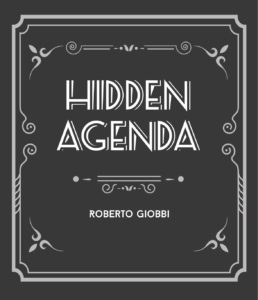
My copies should arrive within the next few days, so if you would like a signed copy dedicated to your name along with an autograph card, you can order directly from me over the webshop HERE.
If you order from a dealer, please do so over Vanishing Inc., the publisher, as it will get me a few Dollars more than if you ordered via any other dealer (but that is fine, too, of course, although this will not even allow me to buy a Cappuccino in Switzerland).
I hope this is good news for all those among you who were looking to complete the Agenda-Trilogy.
The bad news, however, is that Secret Agenda is now out of print, but if you search the Internet you may find some obscure dealer that still has a copy or two left.
I have only TWO copies of Secret Agenda left, and I can positively say that there is no intention of reprinting it, at least not in the same quality than the original.
As I share the copyright with Penguin Magic, I am right now negotiating the possibility of reprinting it via Amazon’s print-on-demand service – the quality of their hardback version will not be the same as the Hermetic Press/Penguin Magic editions, but it is much better than it used to be … at least it is better than nothing.
Unfortunately the costs of paper, printing, shipping, the tariffs, and ultimately AI, are making the book business a difficult one – print-on-demand at the moment seems to be the logical solution.
Briefly: If anyone reading this is interested to acquire a complete set of Agendas (Secret Agenda, Hidden Agenda, Unexpected Agenda), signed and dedicated, with an autograph card, our if you know someone who is interested, I have the last TWO complete sets available, sold only as a set. You cannot order this through the webshop, but if you send me an email over the “contact” menu item of the webshop, I will let you know the shipping costs (the three books are EURO 190).
Fröhlich Zauber Kongress
Hanno Rhomberg, the president of the Magic Circle of Austria, editor and publisher of Aladin, their by-monthly magazine, and organizer of the yearly national convention, invited me to speak about piracy, copyright, and how this affects creators of tricks, books, and videos at his Fröhlich Zauber Kongress magic convention, that took place from September 10 to 13 in Bad Aussee, the geographical center, of Austria (nothing less).
Originally we agreed that I would have twenty minutes to expose a topic which in my opinion is very important and that is sort of a tabu within magic circles, as obviously almost everyone has some kind of illegal PDFs, videos, etc. at home.
So, really no-one wants to speak about this.
A few minutes before going on I was told I had only fifteen minutes, and as I was introduced so much pressure was put on me, that I ended up speaking for twelve minutes … my shortest talk ever 🙂
I cannot hide that the situation at the moment really pissed me off, if you will forgive this vulgar expression, but in hindsight, compared to the tragedies civilization had and has to bear, this is of course immaterial – tempus dolorem lenit.
Anyway, I plan to write down what I said – and wanted to say but could not say – in an essay, which I will publish in one of the upcoming The Magic Memories as I believe some of you will be interested in the simple solutions I offer for this admittedly delicate subject; I know I say that often, but in this case I have put it on my “to-do-list” in the agenda, and there it stands at least a 50% chance of getting done…
Highlights
Generally speaking the convention, which had an international attendance of ca. 300 people, was a most interesting one with some courageous decisions of events that you do not see anywhere else.
One such feature was that there was no “gala show” in the classic sense, where the formula is MC-act-MC-act, etc.
Instead, all the shows were presented by a single person or a group, an idea that met with great approval.
You can get an overview HERE.
Highlights there were many, too many to mention.
Among my favorites was a late-night event by David Eriksson with his one-man show “Apple Saucy”. I and almost everyone in the audience had never heard of him, and I can only urge you to find some videos of him on YouTube – or better go and see him live – as I find it impossible to describe his performance (yes, not an act, but for once really a “performance”), other than calling him a “lovable monster”.
Thomas Otto, a consummate professional from Germany, who gave an outstanding lecture on one single subject, the “Chop Cup”.
I have only attempted once to do an-hour-plus lecture on a single subject and know how difficult it is to convince an audience of mostly amateur magicians that “deep” is more important than “broad”, to paraphrase Ascanio. He did masterfully, and the audience loved him.
Alexander Krist, who closed the convention on Sunday morning by doing a part of his impressive full-evening show he usually features in his theater in Munich. Some of his large scale illusions might have fooled Penn & Teller … maybe.
Magialdia Magic Convention
From September 14 to 20, Vitoria-Gasteiz once again became one of the world’s capitals of magic for the 38th edition of Magialdia. For me it was the 20th attendance since 2005 (I had to leap a year during the pandemic).
More than thirty international performers participated in over forty events, ranging from close-up and stage galas to lectures, book presentations, exhibitions, workshops, street magic, and shows for the general public.
What continues to distinguish Magialdia from most other magic conventions is precisely this combination: it is at the same time a meeting place for professionals and a genuine festival for an entire city. Magic does not merely take place inside a convention center; it appears in museums, theaters, historic buildings, and public squares throughout Vitoria.
The professional program included lectures and presentations by, among others, Marcos Waldemar, Miguel Ángel Gea, Ignacio López, Gabriel Gascón, Céline Noulin, René Mazing, Tino Plaz, and Arthur Chavaudret, plus Paul Wilson’s documentary Tamariz, Love & Magic.
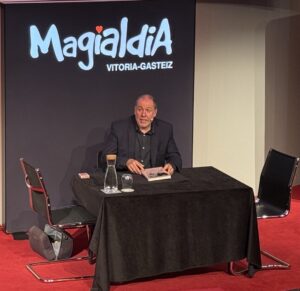
The international galas brought together artists from several countries, with Woody Aragón presenting his own show on Saturday evening.
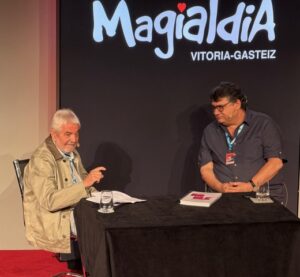
For me, a particularly meaningful moment came on Sunday, when Toni Cachadiña and I presented Jesús Etcheverry’s Reflexiones sobre la carta doble, el manejo de Ascanio—a fitting occasion to remember Jesús and his important contribution to our beloved art.
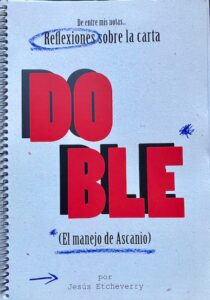 Etcheverry’s notes on Ascanio
The book publication was sponsored by Magialdia, and then sold practically at cost for 20 Euro.
The book, a 300-plus pages oeuvre with hundreds of photos, was produced like the German and Spanish version of Card College, which was the model for this metal-spiral-bound publication that allows the pages to be folded over and the book to lay flat on the table for best learning. This idea of sponsoring an important book for a convention should inspire other clubs to do the same, as a book is a most useful thing to virtually anyone.
(This reminds me that in 1988 Peter Kersten asked me to write a book as a gift for the attendees of the Austrian convention, then held in Vienna – and this was the beginning of the Light-Trilogy!)
Although the book is in Spanish, you can get the English version as a PDF from lybrary.com titled Reflections on the Double Card: Ascanio’s Handling – those who prefer books, can simply have the PDF printed out and bound for little money (e.g., lulu.com).
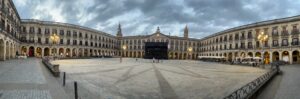
The closing event always takes place on the historical Plaza de España of Vitoria, where hundreds of spectators gather to see the final show.
Magialdia remains one of those rare conventions where magic, friendship, culture, and excellent food meet—and not necessarily in that order.
Fact is, everyone seems to have the time of their life.
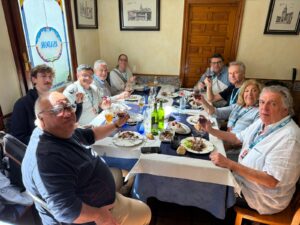
The photo below shows just one of the collateral effects of the Magialdia convention.
The Bordeaux-Rioja-Txacoli Experience
This year was even more special than the others, as I suggested to my friends Nicolas Jeker and Claudio Viotto, both from my hometown Basel and amateur magicians, to come to Magialdia via an extended gourmet tour … they agreed, and had no idea what would await them…
This is not magic, and if food and wine bore you, jump ahead to “Neurosciences and Magic” below.
For the rest of you: I invite you to embark on an extraordinary trip from Switzerland over France to Spain, then back to France and Switzerland.
Our adventure started in Basel, where we took a short 80-minute flight to Bordeaux, arguably the capital of the world of wines.
There we rented a card and swiftly proceeded to St. Emilion in about forty minutes. The Bordeaux wine region has 65 official appellations (AOC – Appellation d’Origine Contrôlée).
Depending on how certain sub-regions and umbrella designations are grouped together by different wine authorities, you will also frequently see references to 57 or 60 appellations in literature.
St. Emilion is not only one of the most famous, along with Margaux and Pauillac, but also a picturesque small town that attracts a lot of tourists. The interesting thing about French wines in particular, and European wines in general, is that the wine is most often called after the village, the vineyard and the producer. So, if you read “St. Emilion, Château Angélus, Premier Grand Cru Classé, 2016″, you know exactly from where the bottle comes, from what vineyard and who produced it. This is different in most parts of the world, where the wines have been given attractive names (“Opus One”) to appeal to the emotions and hopefully encourage sales…
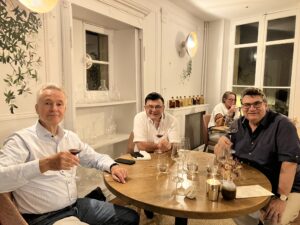
We stayed at a simple IBIS hotel, clean and more than sufficient for one night, and saved the money to be spent on a Chateau Angélus in Le Logis de la Cadène, a restaurant I can recommend, and a lot cheaper than buying a bag from Louis Vuitton, which is absolutely useless (the bag, not the restaurant). We had the “Menu Generous”, which was an uncompromising start into the days to come.
Next day we were off to Vitoria, a five-hour trip crossing the Pyrenees, occasionally along the Atlantic coast, with only a short stop for what the Spanish call “un tentempié”, something that keeps you on your feet (vulgo for “sandwich”).
We arrived safely at the convention hotel NH Canciller, a lovely 20-minute walk from the convention center.
The hotel is just opposite a wonderful park with a bar, where we had our first Vermouth.
Although Vermouth was “invented” by an Italian, Carpano, in Turin, where FISM 2025 took place, in 1786 – I know because this is the year of publication of Decremps’ Testament de Jérome Sharp… and as you can see everything connects to magic making it the facetted diamond where every facet connects to a subject of life – so, in spite of this, Vermouth is a Spanish specialty, and you should by all means drink that at least once when you next go to Spain. In any case, nowhere in the civilized world that I know of are drinks so good, so well-made and so cheap as in Spain.
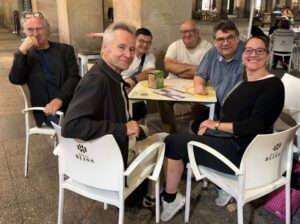
Well, to cut a long story at least a little shorter, let me simply say that during those days in Vitoria we were privileged not only to experience some extraordinary magic—see my brief report above—but also to enjoy a few gastronomic high points.
Should you ever find yourself in Vitoria—and you should do everything within reason to make that happen—I recommend the restaurants La Roca, El Portalón (be sure to order the cochinillo asado in advance), Zaldiaran (currently the most exclusive, but also the most expensive), PerretxiCo, Asador El Matxete (for fish and meat), and a few others whose names I will reveal only under torture… After all, as magicians we should still be allowed to keep a few secrets.
What I certainly do not want to keep secret, however, is our excursion into the Rioja Valley, arguably Spain’s most famous wine region. There we visited an excellent winery run by an up-and-coming winemaker and had what was probably the best cabrito asado of our lives at Mesón Chuchi in Fuenmayor. Naturally, it did no harm that our host, José Ángel Suárez, organizer of the Magialdia Festival, was driving, while his friend Ángel, one of Spain’s finest sommeliers, selected the wines.
Yes, yes, you see what happens when you write books on magic: You may not earn much money, but you are spared quite a few expenses—to paraphrase Schopenhauer (once again…).
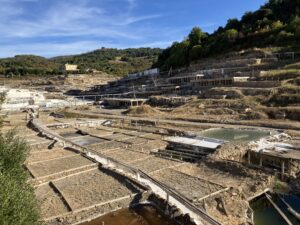
But the best was yet to come—or rather, the second best thing on that Monday after the convention. On our way back we stopped at the Salt Valley of Añana—you had best read about it HERE yourself.
Suffice it to say that this is my favorite salt, particularly their flor de sal, arguably the world’s best fleur de sel.
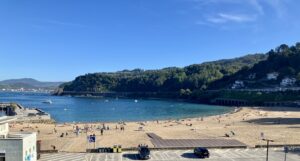
And that conveniently allows me to jump straight to the following day, when we made our way to the northern coast of the Basque Country, more precisely to Getaria, a charming, if somewhat touristy, fishing village, where, after a short walk, we rested in a bar overlooking the beach.
Rested from what, you ask?
From visiting a winery, of course.
Getaria is the center of Txakoli, a local wine produced from indigenous grape varieties and resulting in a wonderfully accessible wine that is still relatively little known—which, fortunately, also means that it remains very reasonably priced. At least until Parker discovers it…
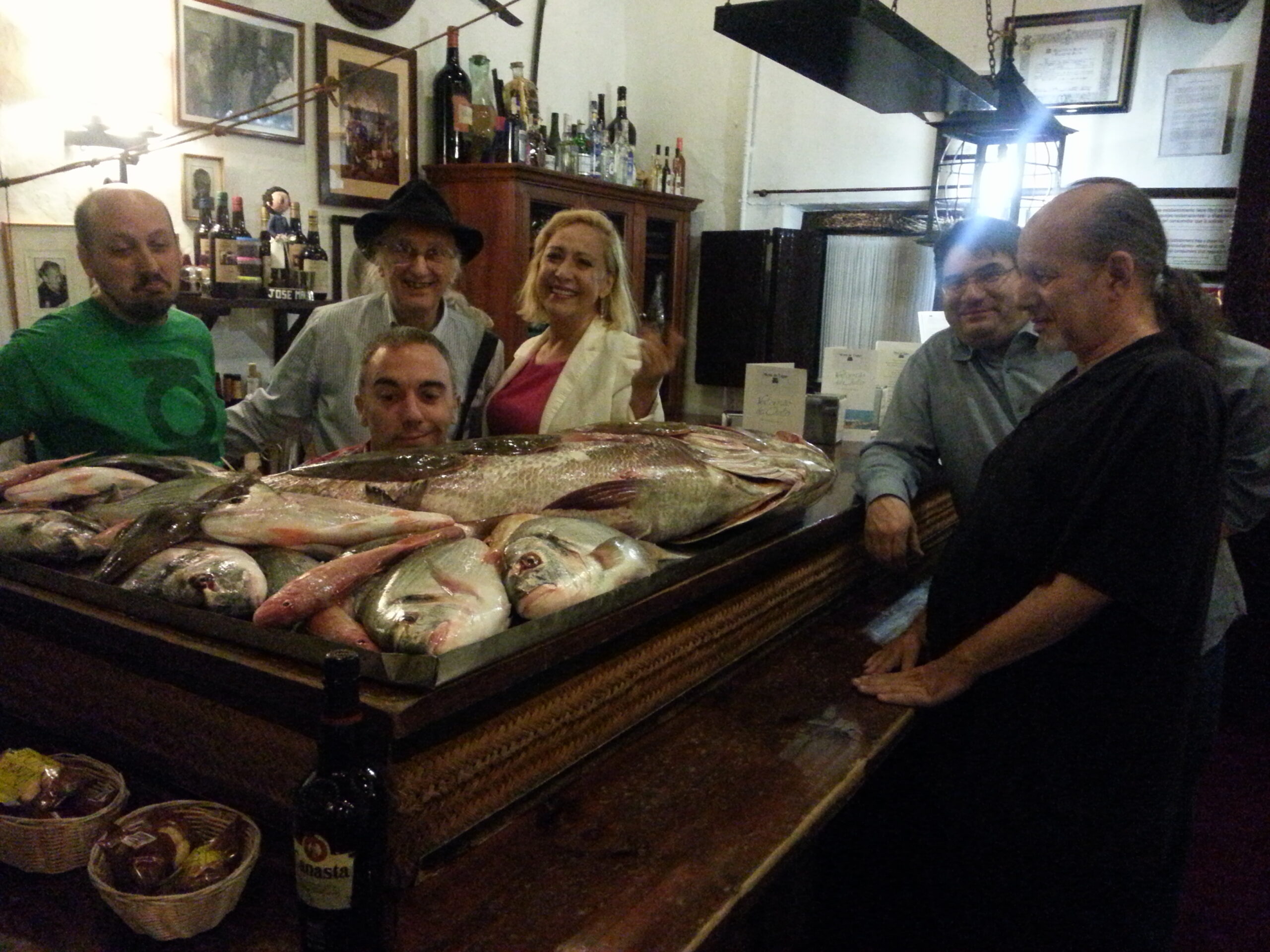
Dinner was at Iribar Jatetxea, and should you ever find yourself there, I strongly recommend the chipirones a la plancha, almejas a la marinera, and kokotxas as starters, followed by grilled besugo (red sea bream), without question one of the best fish I have ever had. One and a half kilos for three people is just about right. Add two bottles of Txakoli—the very least one owes the local winemakers…
And suddenly we had reached the penultimate day of our journey and drove back toward Bordeaux, from where we were due to fly home to Basel the following day.
Before that, however, we made a small detour to Arcachon, a seaside town in an area that produces some of France’s finest oysters.
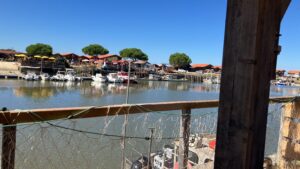
With the help of AI, Nicolas had identified the Cabane à Dégustation des Huîtres Papillon at the Port de Larros in Gujan-Mestras. So that is where we went, and there we enjoyed one of the finest seafood experiences of our trip: oysters accompanied by bread and butter, a little terrine de canard, and a simple Entre-Deux-Mers, a white Bordeaux… what else?
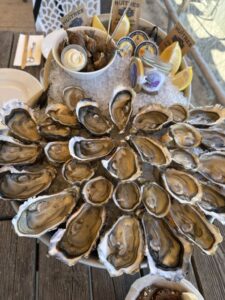
Thus fortified, we were able to pass the rest of the day carefree and content until evening, which we concluded with a delicious côte de boeuf, cooked rare over charcoal, and an excellent Saint-Émilion whose name I have, in fact, forgotten…
I am getting old.
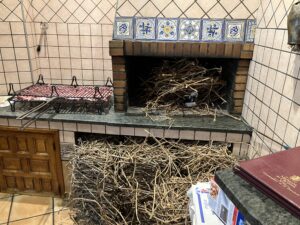
One of the things that strikes me most on this trip, is that we had some extraordinary meals, some complex and expensive, but the two that stand out and that I would repeat if I had the chance to do so, are the lamb chops grilled over vine shoots at Asador Argote in Vitoria and the oysters in the oyster hut in Arcachon.
This reminds me of one of my earliest “shows” I did for a small group of friends in Basel when I was still very young, sitting on the floor, before I even knew that this was Fred Kaps’ preferred performing situation (see Hidden Agenda, February 27 – Kaps on the Floor), the host said to me and the others, “This was better than Copperfield on TV.”
It is obviously irrelevant whether this is true or not – it certainly is not – what counts is the person’s subject reality, his perception, as this is the only reality that counts for the person itself (Copperfield appeared for the first time in German TV on 15th September 1990).
Both my gastronomic experience and the magical one enjoyed by my host and his guests show that creating a memorable experience does not necessarily require spectacular effects. Small, simple, but highly personal experiences can often leave a far greater impression.
Yes, we all know this, but it is good to occasionally remind ourselves of it … to keep things grounded.
Putting order to my things, I run across the prospectus depicted below, which I had picked up at an earlier Magialdia convention..
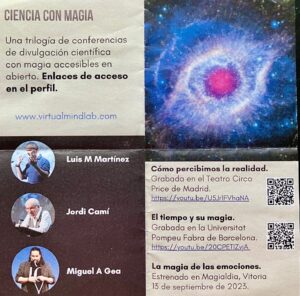
These are three talks that deal with neurosciences and magic. So, if this is your cup of tea, scan the QR-codes, and if these do not work, simply enter the title of the talks into Google and you will get to the talks on YouTube.
Although the presenters speak Spanish, thanks to AI you can have them subtitled or even synchronized in English or any other language (maybe Russian or Chinese, as this may become handy in the near future … or Swahili, my favorite of the 7’164 currently spoken languages in the world, which I do not speak).
FindMagic.show
One of the privileges and pleasures of having written books, which have appeared in now eight languages, is that I get in touch with many interesting people.
Recently Daniel Schwartz, MD, FRCP(C), an amateur magician and a nephrologist by profession wrote in and shared some information that I think will interest some of you.
With his permission, here is what he wrote:
Dear Mr. Giobbi,I’m an amateur magician in British Columbia, although most of my time is spent being a doctor and dad.I recently created a free Mnemonica memory aid designed to help magicians learn the stack and develop card-to-position and position-to-card recall:I struggled considerably when first trying to memorize Mnemonica, so I adapted techniques I had previously used to retain large amounts of medical knowledge. The resulting system is designed to get someone surprisingly close in about 75 minutes, followed by continued practice to develop fluent recall.There is no subscription, upsell, cross-sell or affiliate component. It does not teach effects or attempt to replace Juan Tamariz’s book; it is intended solely as a memorization companion for magicians already studying Mnemonica.Following Juan’s recent passing, I also hope the project can serve in some small way as a tribute to his extraordinary legacy and influence on card magic.
As you will see if you follow the lead, this site is not only useful for those struggling with memorized decks, but also affords plenty of accurate information for those traveling the world and seeking out places to see magic and meet magicians.
Thank you Doctor Schwartz for sharing!
The Tweezers Billet Switch
As I have mentioned on several occasions in my writings, there is much to be gained from browsing old magic magazines.
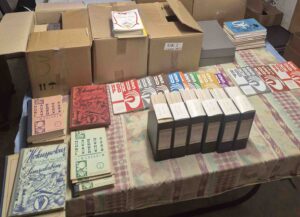
Recently, while attempting to bring some order to my collection of nearly one hundred different magic periodicals from around the world—amounting to well over a thousand individual issues—I found myself unable to resist leafing through them. From time to time, I would pause at a particular issue that intuition suggested might contain something of interest… and, more often than not, it did.
I became engrossed in a remarkable variety of material: reports of magic conventions with detailed accounts of who performed what; reviews of books that would later become classics; profiles of celebrated magicians, but, even more fascinatingly, of those now largely forgotten; and, naturally, a wealth of tricks, sleights, and techniques.
It occurred to me that an interesting project would be to gather my favorite discoveries from these innumerable contributions and publish them in book form. Restricting myself to items published before approximately 1960—most of which are now in the public domain and therefore free of copyright concerns—might result in another kind of Agenda. (Do not worry; I have no intention of writing any more Agendas.)
In The Magic Magazine, edited by the British magician and magic dealer Max Andrews, Volume 4, No. 9 (December 1955), an item on page 239 particularly caught my attention. It bore the intriguing title, “Special! The Tweezer Switch.”
The idea was the creation of George Blake (1893–1979), a distinguished British magician, ventriloquist, author, and inventor of magical effects. Throughout his career, Blake contributed extensively to magical literature, particularly in Britain. He was a prominent figure within the International Brotherhood of Magicians, notably founding the first British Ring of the IBM. He also edited several important publications, including The Budget, Entre Nous, and Max Andrews’ Magic Magazine—the very periodical in which the item under discussion appeared. Over many decades, he was a regular contributor to journals such as The Linking Ring and The Magigram.
In brief, George Blake is precisely the sort of figure who might well top any list of “little-known magicians.” He deserves a full biography, and a collected edition of his contributions to the magical press would undoubtedly make a substantial and fascinating volume. Some of this material survives in the many booklets he published during the 1960s and 1970s, but much remains scattered throughout the pages of long-forgotten magazines.
To read Blake’s ingenious Tweezers Switch, mentioned above, CLICK HERE.
A lot more I would have liked to tell you in today’s The Magic Memories, but alas time is up, and I promise to return next month with The Magic Memories 233, at exactly 0:07 o’clock, on Sunday, 1st November 2026.
Very best wishes,
Roberto Giobbi