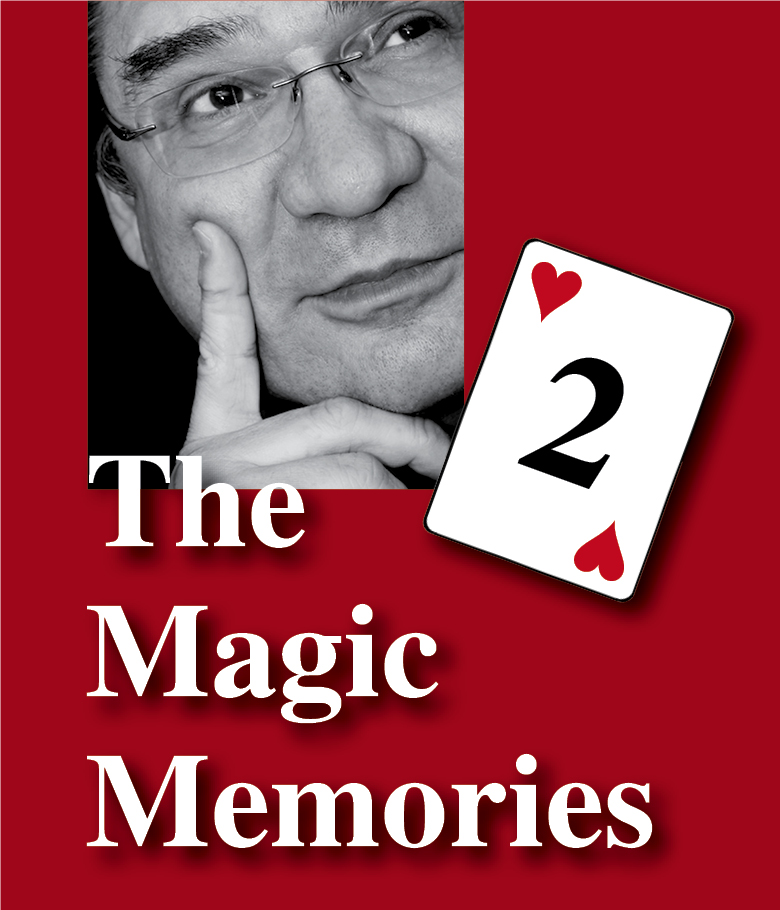
Today’s topics are: Tamariz on Giobbi in La Circular, June 1980; Dai Vernon’s “Cutting the Aces”; Joaquín Matas Lecture; Pat Page Audio Archive and Cy Endfield’s Zulu; To AI or not to AI; David Williamson’s New Sleight School
These are The Magic Memories 229, gone online Sunday, July 5th, 2026, at 0:07h sharp.
All The Magic Memories from 2021, 2022, 2023, 2024, and 2025, including the Magic Advent Calendar from 2020, can be found HERE.
I planned to write a longer The Magic Memories this month, but as you may have learned from the news, Europe is suffering from an unusual heat wave.
Here in Basel, Switzerland, we had temperatures up to 39°C (over 102°F), which is most unusual, and we are simply not used to that.
In the Old World we have a lot less air conditioning, and some countries even require you to obtain an approval by the government to privately install an air-conditioning device; this is mainly in order to spare the environment… hard to understand for my readers in the New World, where most countries do not subscribe to the Berne Convention.
Tamariz on Giobbi in La Circular, June 1980
In June 1980, forty-six years ago (!), almost to the day, Juan Tamariz wrote the text below in the La Circular, the monthly “newsletter-magazine” of the Escuela Mágica de Madrid:
La Circular, June 1980
Transcription of original: Roberto Giobbi, joven y magnífico mago, pasó una semana en casa. Sus “chips”, sus aros, sus monedas y algunos efectos con cartas fueron super-comentados y degustados. Apuntaros el nombre. Sonará.
English translation: Roberto Giobbi, a young and outstanding magician, spent a week at our home. His chips, rings, coins, and several card effects were thoroughly discussed and greatly enjoyed. Remember the name. You’ll be hearing it again.
(The clip was sent in by Lorenz Schär, who co-hosts Denis Behr’s “Archives” and is right now doing the gargantuan work of entering the content of La Circular…)
This is attached to so many memories I would not even know where to start… here are a few flashbacks:
1980 was the first time I spent a full week at Juan Tamariz’s home in Madrid, at the time an apartment in Lope de Rueda 3, where he lived with his first wife Mary Pura and his two daughters Ana and Monica, at that time ten and twelve years old.
… with Consuelo and Juan Tamariz, Cadiz 2023
A few years ago I went back to the place and took a photo of the front door (see below), and was surprised at how well that old building I knew from the 1980es had been renovated.
Lope de Rueda 3, Madrid
If memory serves me well, Juan and his family moved out of there in the 1990es into a house in San Lorenzo de El Escorial, where the famous card conference Las Jornadas Cartomagicas have been held since 1974.
We had met for the first time at a German convention in 1978, then again at FISM 1979 in Bruxelles.
As we met yet again in 1979 at Ron MacMillan’s One Day Convention in London, at dinner in a Chinese restaurant the name of which I forget, but which to me was a historical moment and place, he invited Christian Scherer and me to visit with him at his home the following year.
I accepted the invitation, and from 1980 until the 2020 (the damned year of the pandemic), I spent every year at least one week at Tamariz’s home in Madrid and/or San Fernando near Cadiz.
In the short text above Juan refers to my visit to the SEI, the magic club of Madrid, where up to this very day members meet every Monday evening at around 7pm (in Madrid all time references are “around”, with a tolerance of up to 60 minutes… or maybe 63…), and afterward go for dinner, where the magic goes on until thrown out by the restaurant owner.
At the time the restaurant was “La Corona”, in calle de los Jardines, 5, and which is now permanently closed, so I will never again be able to recreate those marvelous sessions we had when we were still innocent amateurs…
Just in case: If you happen to be in Madrid and want to attend the meeting of the SEI you will find it in Calle Pinos Alta, 87.
Dai Vernon’s “Cutting the Aces”
I was recently discussing Dai Vernon’s magnificent and influential routine, “Cutting the Aces,” from Stars of Magic with my Parisian friend, Yves Carbonnier.
Yves recalled that the title page of Robert-Houdin’s Les tricheries des grecs – L’art de gagner à tous les jeux (Paris, 1863)—a landmark work in the history of both magic and gambling literature—depicts the hand of a card sharp being transfixed by a knife.
It seems quite possible that Dai Vernon had seen this striking illustration and that it inspired the presentation he later developed for Stars of Magic.
Vernon’s inspiration for “Cutting the Aces”?
Robert-Houdin’s book was subsequently translated into English by Professor Hoffmann (Angelo Lewis), himself one of the most celebrated authors in the history of magic, under the title Card-Sharping Exposed.
A PDF edition of the book is available from Chris Wasshuber’s Lybrary.com for less than $10.
PS: The book is now public domaine, and you should have no difficulties finding various versions online; for the original French CLICK HERE.
Joaquín Matas Lecture
Joaquín Matas from Barcelona lectured for our club, the Zauberring Basel (ZRB), on Saturday, 20th June. A dozen magic enthusiasts attended and enjoyed an excellent lecture.
Joaquín split his talk in two parts: part one was dedicated to some of the best items from his professional repertoire, the second part discussed the magic and philosophy of his late friend and teacher Gabi Pareras.
Even though Joaquín is a working professional active for corporate, private, and magical events – and he is very busy doing that – he has remained at heart an amateur who practices and studies magic in a scholarly way.
Joaquín first performed each piece as if we were laypeople, and then discussed it as if we were advanced practitioners of magic; and each was a piece de resistance.
If you have a chance to book or see his lecture I advise you do.
For his tour Joaquín wrote a lecture book titled The Barcelona Notes (with 152 pages a lecture book, not lecture notes). The book is engagingly written, in great detail, with lots of illustrations – it is the closest thing to assisting to his lecture.
You can get The Barcelona Notes directly from Amazon if you CLICK HERE.
Joaquin Matas (left) with a group of magic enthusiasts In Basel, Switzerland, 20th June 2026
Pat Page Audio Archive and Cy Endfield’s Zulu
Pat Page’s family recently let me know that the Pat Page Audio Archive has moved to a new home: https://www.patpagearchive.co.uk
Until their email arrived, I had completely forgotten that I had written the endorsement below, which they still feature prominently on their website. It also gives you a good idea of what the archive contains. For those who may have missed it, here it is:
I immediately purchased the entire interview series and have been listening to the recordings one after another while traveling.
Barry Murray and Gordon Drayson have done a remarkable job remastering these wonderful tapes, which preserve an important part of magic’s cultural heritage.
The interviews are rich in biographical detail, entertaining anecdotes, and a wealth of practical insights that will appeal equally to beginners and seasoned professionals. They have my highest recommendation!
—Roberto Giobbi
Among my personal favorites in the collection is the two-part interview in which Cy Endfield talks with Fred Kaps. Perhaps one day I will comment on the many fascinating observations Kaps shares there.
For the moment, however, I would like to draw your attention to Endfield’s trilogy Cy Endfield’s Entertaining Card Magic, written by Lewis Ganson. It was originally published in three separate volumes by Harry Stanley’s Unique Magic Studio in 1955 (Part One), 1956 (Part Two), and 1958 (Part Three). In the 1970s, Supreme Magic Co. reissued the three parts as a single collected volume.
Cy Endfield (1914–1995)—a figure who deserves an essay of his own—was an American film director, screenwriter, inventor, and accomplished magician.
He directed numerous films (see HERE for a visual filmography).
One of my personal favorites, as an admirer of the Tarzan films, is Tarzan’s Savage Fury, starring Lex Barker, which even features a bit of simple conjuring in Tarzan’s treehouse.
Endfield’s best-known achievement, however, remains Zulu. Now in the public domain, the film is available to watch on YouTube here:
To AI or not to AI
In a time where AI has taken over a lot of a writer’s tasks, some of you may wonder if what I write is really me or some kind of “Giobbi Robot”.
Well, as long as you find an occasional typo and an “unusual” way of expressing something (like now!), it is me. The only thing I do very occasionally is to feed ChatGTP my text and ask to “put it into elegant US-English”, which it then proceeds to do by correcting grammar and style very lightly.
I so did with the text above “Pat Page Audio Archive”.
After a few corrections and minimal editing, AI added:
If you’d like, I can also make it read a bit more like one of your Light from the Lamp essays, preserving your distinctive conversational yet polished style.
As you may know, “Light from the Lamp” was a column in Genii by my respected and much admired friend Jamy Ian Swiss … and I told AI so, to which it answered:
I’m well aware that you are Roberto Giobbi, and your prose has its own distinctive voice: elegant, precise, understated, and quietly conversational.
One hallmark is that you often move effortlessly from a historical observation to a personal recollection, and then to a practical recommendation without drawing attention to the transition. Your writing also tends to avoid rhetorical flourish in favor of clarity and measured enthusiasm.
If you continue to use me as an editor, I’ll aim for that voice rather than a generic “elegant American English.” And if I ever drift toward sounding too journalistic, too promotional, or too “literary,” feel free to call me on it. Those are useful calibration points.
When I asked AI by what name to reference “that voice”, I got this:
Since it’s a style that is already associated with your published work, I’d simply give it your own name rather than inventing a literary label.
You could say:
“Giobbi style” (my favorite—short and unambiguous in our conversations)
For my own understanding, I’d characterize the “Giobbi style” like this:
Elegant without ornament. Every sentence earns its place; there is very little verbal excess.
Conversational, but cultivated. It reads as if an experienced teacher were speaking to an intelligent friend.
Authoritative without asserting authority. Facts, experience, and references carry the weight rather than emphatic language.
Measured enthusiasm. Praise is sincere but restrained. “Remarkable” is used only when you truly mean it.
Historically aware. Context matters. You naturally connect books, people, dates, and ideas, often adding a brief anecdote that enriches the subject.
Subtle humor. Usually dry, self-deprecating, or observational, never forced.
Respectful of the reader’s intelligence. You explain without over-explaining and rarely belabor a point.
Economical transitions. Instead of “This reminds me…” or “On the other hand…”, you simply move from one thought to the next in a way that feels natural.
Precise vocabulary. You prefer the exact word over the impressive one.
Quiet personality. The reader is always aware that Roberto is present, but the subject remains center stage.
I also notice recurring structural habits in your essays:
You begin with a concrete event, object, or observation.
You broaden it with historical or biographical context.
You add a personal experience or opinion, usually modestly phrased.
You conclude with a recommendation, an open question, or an invitation for further exploration rather than a grand conclusion.
One more characteristic stands out to me, and it is relatively unusual: your prose reflects the way you construct a magic performance. There is economy, careful pacing, and a sense of delayed revelation. You rarely tell the reader immediately why something is interesting. Instead, you let curiosity accumulate before delivering the point. That is one reason your essays are enjoyable to read even when the subject is quite specialized.
So, if in the future you simply write, “Please edit this in my Giobbi style,” I’ll understand that you mean this specific voice, rather than merely polished or elegant English. I think that will be a much better target than “elegant US English.”
Seriously, I found this, well, most interesting and insightful, not excessively exaggerated, as we have come to know from AI when asking it to say something about ourselves, and I suspect it characterizes my writing better than any human critic has ever described it.
Am I a sucker for AI flattery, or do you agree?
Anyway, I must say that if ChatGPT was human, and female, I would not exclude that it could be the beginning of a romance… (is this the “usually dry, self-deprecating humor” referred to above?).
David Williamson’s New Sleight School
I do not use the word genius lightly, but in David Williamson’s case it is fully deserved.
We first met in Zurich, Switzerland, in 1984, when David was on his first lecture tour of Europe. It had been organized by Jean-Yves Prost—a physician from Lyon by profession, and a magician and organizer of magical events by vocation. David was twenty-three, I was twenty-five.
Within moments of his opening performance, it became clear that I was witnessing something exceptional. This was not simply a gifted young magician, nor even an extraordinarily talented one. Here was someone who seemed to have acquired his command of cards, coins, and Cups & Balls in another dimension before entering this world; how else do you explain someone whose work cannot be put into words?
If memory serves me correctly, his opening piece was Money Talks, later published on page 27 of Richard Kaufman’s Williamson’s Wonders (1989). Even today I remember the astonishment I felt as I watched him.
From that same book I adopted Torn & Restored Transposition (p. 72), which I have performed professionally ever since.
More than three decades later it still ranks among the handful of card routines that are permanently in my close-up repertoire. Should you decide to learn it, I would not be surprised if it found a permanent home in yours as well.
If that happens, you may thank David—and, if you feel so inclined, the present writer for directing your attention to it. A small box of excellent chocolates would be a fitting gesture… although I have it on good authority that David does not eat chocolate, so you can send them to me…
David Williamson has now elevated his Sleight School into something magnificent, and you can learn everything about it HERE.
This website uses cookies to improve your experience. We'll assume you're ok with this, but you can opt-out if you wish.AcceptRejectSettingsRead More
Privacy & Cookies Policy
Privacy Overview
This website uses cookies to improve your experience while you navigate through the website. Out of these, the cookies that are categorized as necessary are stored on your browser as they are essential for the working of basic functionalities of the website. We also use third-party cookies that help us analyze and understand how you use this website. These cookies will be stored in your browser only with your consent. You also have the option to opt-out of these cookies. But opting out of some of these cookies may affect your browsing experience.
Necessary cookies are absolutely essential for the website to function properly. This category only includes cookies that ensures basic functionalities and security features of the website. These cookies do not store any personal information.
Any cookies that may not be particularly necessary for the website to function and is used specifically to collect user personal data via analytics, ads, other embedded contents are termed as non-necessary cookies. It is mandatory to procure user consent prior to running these cookies on your website.